LED VS CFL VS HALOGEN — WHICH LIGHT IS BEST FOR INDIAN HOMES?
In 2026, LED is the clear winner for Indian homes — consuming up to 80% less electricity than halogen, lasting 25 times longer, producing minimal heat, and delivering superior colour rendering (CRI 80+) across all applications. CFL was a transitional technology that is now being phased out. Halogen remains useful only in very specific high-intensity display applications. If you are building, renovating, or simply replacing bulbs in an Indian home, LED is the only technology worth specifying.
This guide covers the complete comparison — energy efficiency, lifespan, colour quality, cost, and the right choice for every room in your home.
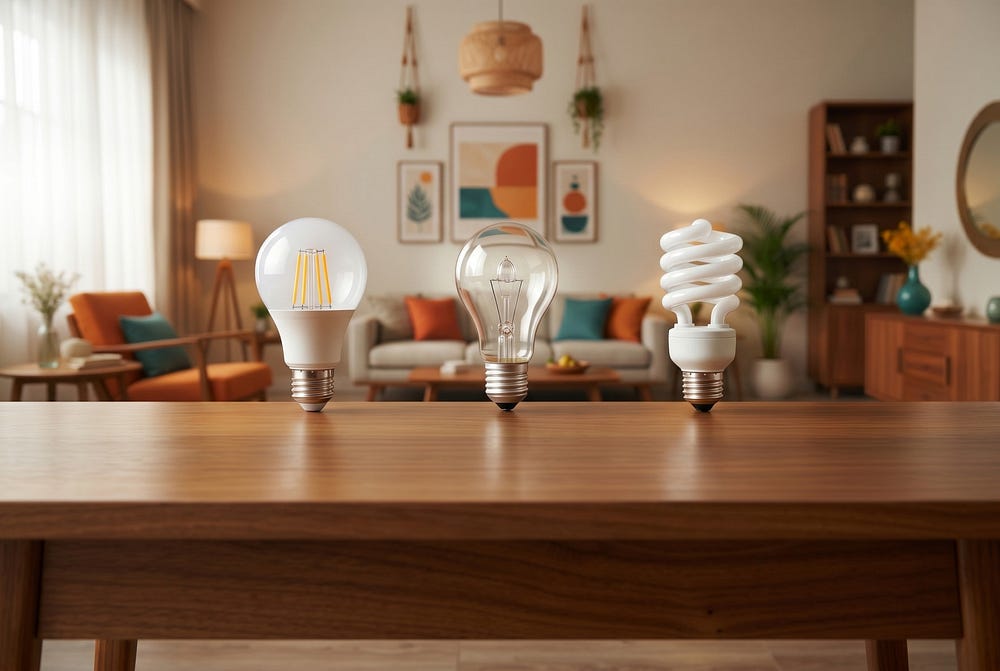
What Are LED, CFL, and Halogen Lights?
Before comparing, it helps to understand how each technology actually works — because the differences in physics directly explain the differences in performance.
LED (Light Emitting Diode) An LED converts electrical energy directly into light using a semiconductor diode. There is no filament to burn out, no gas to deplete, and almost no energy wasted as heat. Modern SMD (Surface Mount Device) and COB (Chip on Board) LED technologies deliver high-lumen output from compact, low-wattage packages.
CFL (Compact Fluorescent Lamp) A CFL produces light by passing an electric current through mercury vapour, which emits ultraviolet radiation that excites a phosphor coating inside the tube. CFLs use significantly less energy than halogen but contain mercury — making disposal a serious environmental concern in India where e-waste management infrastructure is limited.
Halogen A halogen bulb is an advanced incandescent — a tungsten filament sealed with halogen gas that burns hotter and brighter than a standard bulb. Approximately 80% of the energy it consumes is released as heat, not light, making it the least efficient of the three by a significant margin.
LED vs CFL vs Halogen — Complete Comparison Table
FeatureLEDCFLHalogenEnergy Consumption8–12W13–18W35–60WEquivalent Brightness800 lumens800 lumens800 lumensLumens per Watt80–100 lm/W45–60 lm/W16–24 lm/WLifespan25,000–50,000 hrs8,000–15,000 hrs2,000–4,000 hrsHeat ProducedVery lowModerateVery high (80%)CRI (Colour Quality)80–95+60–8095–100Contains MercuryNoYesNoDimmableYes (most)RarelyYesInstant Full LightYesNo (warm-up time)YesBEE Star Rating5 Star3–4 StarNot ratedBest ForAll applicationsBudget retrofitsDisplay/galleryVerdict✅ Best⚠️ Phasing out❌ Avoid
Energy Efficiency — Why It Matters for Indian Homes
India’s electricity tariffs vary significantly by state and consumption slab. In most urban areas, households consuming above 200 units per month pay higher per-unit rates under progressive tariff structures.
A typical Indian home has 20–30 light points. The difference in electricity consumption between halogen and LED across those points is dramatic.
Monthly Electricity Comparison — 20 Light Points, 6 Hours Daily
Light TypeWattageMonthly UnitsApprox. Monthly Cost*Halogen50W × 20 = 1000W180 units₹1,440CFL15W × 20 = 300W54 units₹432LED10W × 20 = 200W36 units₹288
*Based on ₹8/unit average tariff
Annual saving — LED vs Halogen: ₹13,824 per year. Annual saving — LED vs CFL: ₹1,728 per year.
This is why the Bureau of Energy Efficiency (BEE) in India rates LEDs at 5 stars — the highest efficiency classification — and has been phasing out CFL and halogen through the UJALA scheme since 2015.
Lifespan — The Real Cost of Each Technology
The purchase price of a bulb tells you very little about its actual cost. The total cost of ownership — purchase price plus electricity plus replacement — tells the complete story.
Total Cost Over 25,000 Hours (LED Lifespan)
LEDCFLHalogenBulbs needed12–36–12Purchase cost₹150–300₹200–400₹100–200Electricity cost₹200₹325₹1,000+Total cost₹350–500₹525–725₹1,100–1,200+
Over the lifespan of a single LED bulb, you would replace a halogen bulb 6 to 12 times and pay 5 times more in electricity. The maths is not close.
Colour Quality — CRI and What It Means for Your Home
CRI (Colour Rendering Index) measures how accurately a light source renders colours compared to natural daylight. A CRI of 100 is perfect — every colour looks exactly as it would in sunlight. A low CRI makes colours look washed out, dull, or inaccurate.
Light TypeCRI RangeEffect on InteriorsLED (standard)80–85Good — suitable for most roomsLED (high CRI)90–95+Excellent — colours vibrant and trueCFL60–80Poor — colours look flat and greenishHalogen95–100Excellent — but at enormous energy cost
This is where halogen has historically had one genuine advantage — colour accuracy. High-CRI halogen was preferred in art galleries, jewellery displays, and retail because colours looked perfect under it.
However, high-CRI LED now matches halogen’s colour quality at a fraction of the energy cost. LEDs with CRI 90+ are now widely available in India and are the standard specification for premium residential projects.
At Brightmatic, all our architectural lighting design projects specify LED fixtures with CRI 90+ minimum — delivering halogen-quality colour rendering with LED efficiency.
Colour Temperature — Warm vs Cool Light
Colour temperature — measured in Kelvin (K) — determines whether your light feels warm or cool. This is independent of the bulb technology (LED, CFL, or halogen) but is a critical specification decision.
CCTColourBest For2700KWarm whiteBedroom, living room, hospitality3000KWarm whiteMost residential rooms — versatile4000KNeutral whiteKitchen, bathroom, study5000K–6500KCool/daylightTask areas, retail display
Halogen naturally produces a warm 2700–3000K light. CFLs were known for producing an unpleasant cool or greenish tone in early versions. Modern LEDs are available across the full spectrum — and tunable white LED systems can shift CCT throughout the day, supporting circadian rhythm and human centric lighting principles.
CFL and Mercury — Why It Matters in India
Every CFL bulb contains 3–5 milligrams of mercury — a neurotoxin. In developed countries, CFLs must be disposed of at designated e-waste collection points. In India, the reality is that most CFLs end up in general household waste, where broken bulbs release mercury into soil and water.
This is one of the strongest environmental arguments for switching entirely to LED — which contains no mercury, no hazardous gases, and no toxic materials that require special disposal.
The Indian government recognised this. The UJALA scheme distributed over 360 million LED bulbs across India between 2015 and 2022, directly displacing CFL and incandescent technology at scale.
Which Light is Best for Each Room in an Indian Home?
Room-by-Room LED Specification Guide
RoomWattageCCTCRITypeLiving Room8–10W2700–3000K90+Downlight + cove LEDMaster Bedroom6–8W2700K90+Downlight + bedsideKitchen10–12W3000–4000K85+Downlight + under-cabinetBathroom8W3000K85+Downlight + mirror lightStudy/Office10W4000K80+Downlight + task lightStaircase5–6W2700–3000K80+Recessed wall lightOutdoor/Facade10–15W2700–3000K80+IP65 rated LED
For outdoor and facade applications, always specify IP65 or higher rated LED fixtures — especially critical during Indian monsoon season. Our guide on monsoon-proof outdoor lighting covers IP ratings in detail.
Smart LED — The Next Step Beyond Simple Bulb Replacement
If you are building a new home or undertaking a major renovation, replacing bulbs one by one is the wrong approach. The right approach is to specify a smart lighting control system from the start — where LED fixtures are integrated with dimmers, occupancy sensors, and scene controllers.
What smart LED systems deliver:
- Dimming — LEDs dim smoothly from 100% to 1%, unlike CFL (which cannot dim) and halogen (which dims but wastes more energy at higher levels)
- Scene control — One tap sets the right combination of brightness and CCT for every moment
- Occupancy sensing — Lights switch off automatically in empty rooms — reducing electricity consumption by an additional 20–30%
- Tunable white — CCT shifts automatically throughout the day, supporting natural sleep-wake cycles
- Energy monitoring — Smart systems track consumption per circuit, identifying waste in real time
At Brightmatic, we integrate LED fixtures from brands like Lafit Lighting — high-CRI, IP-rated, professionally specified luminaires — into KNX smart lighting control systems for luxury residences across India.
LED vs CFL vs Halogen — The Final Verdict for Indian Homes 2026
QuestionAnswerWhich uses least electricity?LED — 80% less than halogen, 30% less than CFLWhich lasts longest?LED — 25,000–50,000 hoursWhich has best colour quality?LED (CRI 90+) = Halogen. Both beat CFL.Which is safest?LED — no mercury, no heat hazardWhich is dimmable?LED — yes. CFL — mostly no. Halogen — yes but inefficient.Which should you buy in 2026?LED — alwaysOne exception for halogen?High-intensity display or gallery spotlighting onlyIs CFL worth buying?No — it is a transitional technology being phased out
If you are building a new home, renovating, or simply looking to upgrade your lighting to high-quality LED — our team at Brightmatic can specify the right fixtures, colour temperatures, and smart control system for every room.
We have designed and installed LED lighting solutions across luxury residences, commercial spaces, and hospitality projects across India.
Originally Published at:
https://www.brightmatic.in/insights/led-vs-cfl-vs-halogen-best-light-indian-homes-2026


Comments
Post a Comment