What is ABB i-bus KNX — Complete Guide
ABB i-bus KNX is a wired building automation system from ABB — one of the world’s largest electrification companies — that connects every electrical function in your home through a single KNX-certified twisted-pair bus cable. Lighting, climate control, blinds, security, energy management, and audio — all controlled through one unified, internet-independent system that delivers documented energy savings of up to 30% compared to conventional non-automated electrical installations.
Who is ABB and Why Does it Matter
Before understanding ABB i-bus KNX, it is important to understand who ABB is — because the credibility of the system rests entirely on the credibility of the company behind it.
ABB is a Swiss-Swedish multinational technology corporation founded in 1988, operating in over 100 countries with more than 105,000 employees worldwide. It is a global leader in electrification, automation, motors, drives, and robotics — the same company whose technology powers one in four of the world’s data centers, automates shipping vessels, and manages electrical distribution for utilities across six continents.
In India, ABB manufactures switches at a state-of-the-art smart building factory in Bengaluru — one of the first Indian facilities to use ABB’s YuMi collaborative robot for assembly. This factory produces over one million switches annually, all ISI marked and designed specifically for Indian electrical conditions.
When you install ABB i-bus KNX in your home, you are installing the same automation technology platform used in premium hotels, corporate headquarters, hospitals, and luxury residences across Europe, the Middle East, and Asia. The same ETS programming environment. The same KNX bus topology. The same 30-year proven reliability.
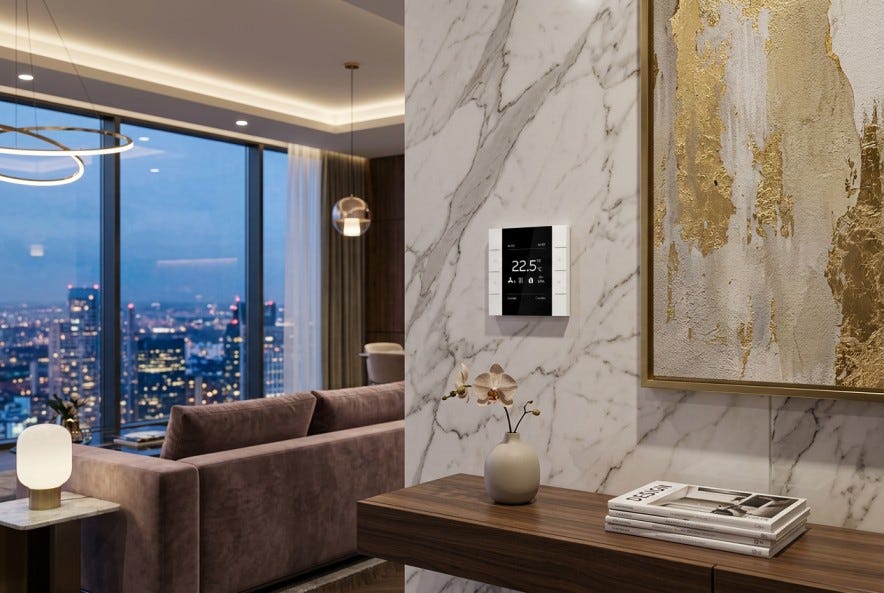
What Exactly is ABB i-bus KNX?
ABB i-bus KNX is ABB’s implementation of the KNX standard — the world’s first and only open international standard for building and home automation (EN 50090, ISO/IEC 14543).
“i-bus” refers to the installation bus — the dedicated twisted-pair cable network that runs through your building parallel to the normal power supply. All KNX devices — sensors, actuators, controllers — connect to this bus and communicate with each other through standardized KNX telegrams.
What makes it “open”: Any KNX-certified device from any of the 500+ KNX member manufacturers worldwide works with ABB i-bus KNX. An ABB dimmer actuator works with a Core Smart Home touch panel. A Siemens presence sensor works with ABB switching actuators. The open standard eliminates proprietary lock-in — your system can grow with the best products from any manufacturer.
What makes it “intelligent”: Unlike a Wi-Fi smart switch that controls one circuit independently, ABB i-bus KNX creates a networked building brain. Every sensor communicates with every actuator. A presence detector in the hallway not only controls the lights — it simultaneously adjusts the thermostat, lowers the blinds if the sun is shining, and updates the security system’s occupancy status.
How ABB i-bus KNX Works — The Technical Architecture
Understanding the architecture removes the mystery behind KNX and helps you have informed conversations with your installer and architect.
The Bus Topology
The KNX bus cable is a dedicated 2-wire twisted-pair cable (red/black, YCYM 2×2×0.8mm) that runs from a central KNX power supply unit throughout the building — parallel to but completely separate from your 230V mains electrical supply.
Every KNX device connects to this bus. Sensors (push buttons, presence detectors, temperature sensors) send telegrams onto the bus. Actuators (dimmers, switching actuators, blind motors, HVAC gateways) receive these telegrams and execute actions.
The Telegram System
When you press an ABB KNX push button, the button generates a KNX telegram — a small data packet containing the sender’s address, the target group address, and the command value. This telegram travels along the bus at 9,600 bits per second to all connected devices. The relevant actuator reads the telegram, executes the command, and sends a status confirmation back.
Response time: Under 200 milliseconds from button press to light activation.
The Group Address System
The power of KNX is in group addressing. A single button press can send one telegram that simultaneously controls 50 different actuators across the building — dimming the living room, closing the blinds, lowering the AC setpoint, and activating the outdoor facade lighting — all triggered by a single “Evening” scene command.
ABB i-bus KNX — Complete Product Range
ABB offers one of the most comprehensive KNX product portfolios in the world. For Indian residential and commercial installations, the following product categories are most relevant:
Sensors and User Interfaces
ProductFunctionKey FeatureABB-tacteo KNXCapacitive push button sensorCustom icons, luxury hotel gradeMillenium SeriesSmart modular switchesISI marked, India manufacturedZenit SeriesPremium switches + audio130+ functions, Bluetooth audioPresence DetectorsMotion/occupancy sensingIndoor + outdoor variantsTemperature SensorsRoom climate sensingSlim flush-mount designLight SensorsDaylight measurementConstant light control
Actuators
ProductFunctionCapacitySwitch ActuatorsOn/Off switchingUp to 12 independent outputsDimmer ActuatorsDALI/phase-cut dimmingMultiple channel optionsBlind/Shutter ActuatorsMotor controlUp to 4 independent channelsDALI GatewayKNX-DALI bridgeControls 64 DALI devicesHeat/Cool ActuatorHVAC controlFan coil + valve control
System Components
ProductFunctionKNX Power Supply24V DC bus powerLine CouplerConnect multiple bus linesIP InterfaceRemote access via networkUSB InterfaceETS programming connectionABB Smart Touch 10"KNX visualization panelBusch-Comfort Touch Advanced KNX panel with IP cameras
ABB i-bus KNX vs ABB free@home — Understanding the Difference
ABB offers two smart home systems — and the distinction matters significantly for Indian homeowners deciding between them.
FeatureABB i-bus KNXABB free@homeInstallation typeWired — KNX bus cableWireless — no bus cable neededBest forNew construction / full renovationRetrofit / existing buildingsScalabilityUp to 57,375 devicesLimited to free@home ecosystemOpen standardYes — any KNX device worksNo — ABB free@home onlyReliabilityHighest — wired infrastructureHigh — wirelessComplexityHigher — requires ETS programmingLower — app-based configurationCostHigher initial investmentLower initial investmentLongevity20–30 years10–15 yearsInternet dependencyZero — fully localPartial — some features need cloudEnergy savingsUp to 30% documentedUp to 20% typical
Our recommendation for Indian homes: If you are building new or doing a complete renovation — ABB i-bus KNX is the correct choice. If you are retrofitting an existing completed home without wall cutting — ABB free@home is the practical solution.
ABB-tacteo KNX — The Luxury Interface
The ABB-tacteo KNX is the flagship user interface in ABB’s premium product range — designed for first-class hotels, luxury residential buildings, and high-end commercial spaces where both aesthetics and functionality are uncompromising requirements.
Key features:
- Capacitive touch surface — no mechanical moving parts
- Custom icons and text on each button — engraved or printed
- Available in black glass, white glass, stainless steel finishes
- Individual color LED backlighting per button
- Compatible with Apple HomeKit, Amazon Alexa, Google Assistant
- Configurator tool — design your exact panel online before ordering
In premium Indian projects, the ABB-tacteo replaces the conventional modular switch plate entirely. A single ABB-tacteo panel in brushed stainless steel — with custom-engraved icons for “Chandelier,” “Reading,” “Away,” and “Night” — controls the entire room’s lighting layers, blinds, and AC through precisely programmed KNX scenes.
ABB Millenium and Zenit Switches — Made in India
For Indian homeowners who want ABB KNX functionality at a more accessible price point, the Millenium and Zenit series offer full smart home capability in ISI-marked, Indian-manufactured switches.
Millenium Series
- Ultra-slim design — premium sleek finish
- 50+ functions including full building automation
- Compatible with ABB i-bus KNX
- Upgradable to free@home wireless system
- Manufactured at ABB’s Bengaluru factory
Zenit Series
- 130+ functions — the most comprehensive in the range
- Multi-room audio including FM radio and Bluetooth
- Screwless metallic mounting grids
- Available in multiple modern finishes
- Suitable for medium to large commercial projects
Energy Savings — The Business Case for ABB i-bus KNX in India
ABB documents up to 30% energy savings in buildings using i-bus KNX compared to conventional non-automated installations. In Indian conditions — where electricity costs are rising and power cuts are common — this translates directly into measurable financial returns.
How Energy Savings Are Achieved
Presence-controlled lighting — Lights automatically switch off in unoccupied rooms. In a typical Indian home where family members frequently leave lights on in empty rooms, presence control alone delivers 15–20% lighting energy reduction.
Constant light control — Light sensors measure natural daylight entering each room and automatically dim artificial lighting to maintain a consistent lux level. On bright Indian afternoons, ceiling lights may dim to 20–30% — or switch off entirely — while maintaining the same visual comfort.
HVAC optimization — The KNX thermostat system monitors room occupancy. When a room is empty, the AC automatically shifts to economy mode. When a window is opened, the AC pauses — preventing cooling an open space, which is one of the most common sources of energy waste in Indian homes.
Scheduling — All circuits follow programmed schedules. Exterior lights activate at sunset and deactivate at midnight. The garden irrigation pump runs only during off-peak electricity tariff hours. The water heater activates 30 minutes before the scheduled morning routine — not 24 hours continuously.
Energy Savings Calculator — Indian Context
Home TypeBaseline Monthly BillWith ABB KNXMonthly Saving3BHK Apartment₹4,000₹2,800₹1,2004BHK Villa₹8,000₹5,600₹2,400Luxury Bungalow₹18,000₹12,600₹5,400
At ₹2,400 monthly saving for a villa, the automation system begins returning its investment within 3–5 years — after which the savings are pure financial benefit for the life of the building.
Voice Control — Alexa, Google, and Apple HomeKit
ABB’s Busch-Voice Control KNX bridges the ABB i-bus KNX system with all three major voice assistant platforms — Amazon Alexa, Google Assistant, and Apple HomeKit — allowing complete voice control of all KNX functions.
What you can control by voice:
- Any individual KNX device — “Alexa, turn off the study light”
- Complete scenes — “Hey Google, activate Movie Night”
- Climate — “Siri, set living room to 23 degrees”
- Blinds — “Alexa, close all blinds”
- Security — “Hey Google, arm the alarm”
How it works technically: The KNX IP interface connects your ABB installation to your home network. Busch-Voice Control KNX creates a secure encrypted tunnel between your local KNX installation and the cloud voice assistant infrastructure. All local functions continue to work without internet — voice control is the only function that requires connectivity.
ABB i-bus KNX + Brightmatic — What a Complete Installation Looks Like
At Brightmatic, we combine ABB i-bus KNX with our architectural lighting design expertise to deliver complete smart home ecosystems for premium Indian residences.
A typical Brightmatic ABB KNX installation includes:
Lighting Layer — Our architectural lighting design creates the cove lighting, recessed downlight, and accent spotlight specifications. ABB DALI Gateway and dimmer actuators control every circuit with 0–100% dimming precision.
Control Layer — Our lighting control installation includes ABB-tacteo KNX sensors in premium finishes at every key control point, programmed with custom scenes tailored to how the family actually lives in the space.
Security Layer — ABB presence detectors integrate with our security surveillance system — occupancy data from lighting automation feeds the security system simultaneously.
Human-Centric Layer — ABB tunable white dimmer actuators integrate with our human-centric lighting solutions — automatically shifting color temperature throughout the day.
- In a recent project at a 5,200 sq ft independent villa in Sector 44, Noida — we installed a complete ABB i-bus KNX system covering 94 KNX devices across four floors. The client’s electricity bill reduced from ₹22,000 to ₹14,800 per month within the first billing cycle after commissioning. The system paid for its lighting automation component within 4.2 years.
Planning Your ABB i-bus KNX Installation — What to Do Before Construction
The single most important rule in ABB i-bus KNX installation: plan before you build.
KNX bus cable must be routed during the electrical rough-in phase — before walls are plastered and ceilings are fixed. Retrofitting KNX cable into a completed building costs 3–4 times more than planned installation and compromises aesthetics.
Pre-Construction Checklist
KNX bus cable routing — YCYM 2×2×0.8mm from every sensor position back to a central distribution panel. Route alongside but separate from mains power cables — minimum 4cm separation.
Sensor positions — Mark every push button, presence detector, and temperature sensor position on the architectural drawings before wall work begins.
Actuator panel location — KNX DIN rail actuators install inside a dedicated electrical panel. Plan adequate panel space — typically 4–8 DIN rail modules per room.
Power supply location — One KNX power supply per 64 devices maximum. Plan power supply positions within the panel.
IP interface location — For remote access and voice control integration, an IP interface needs an Ethernet connection at the panel.
Originally Published at:
https://www.brightmatic.in/insights/what-is-abb-i-bus-knx-complete-guide


Comments
Post a Comment