How to Plan Home Lighting Before Construction
Planning your home lighting before construction begins is the single most important decision you will make for your interior — and the one most Indian homeowners make too late. Lighting conduits, switch positions, circuit zoning, and false ceiling pockets must all be decided before plastering begins. Once the walls are closed, making changes costs significantly more and often means breaking finished surfaces.
This is a complete guide to planning home lighting from scratch — for anyone building a new home or undertaking a major renovation in India.
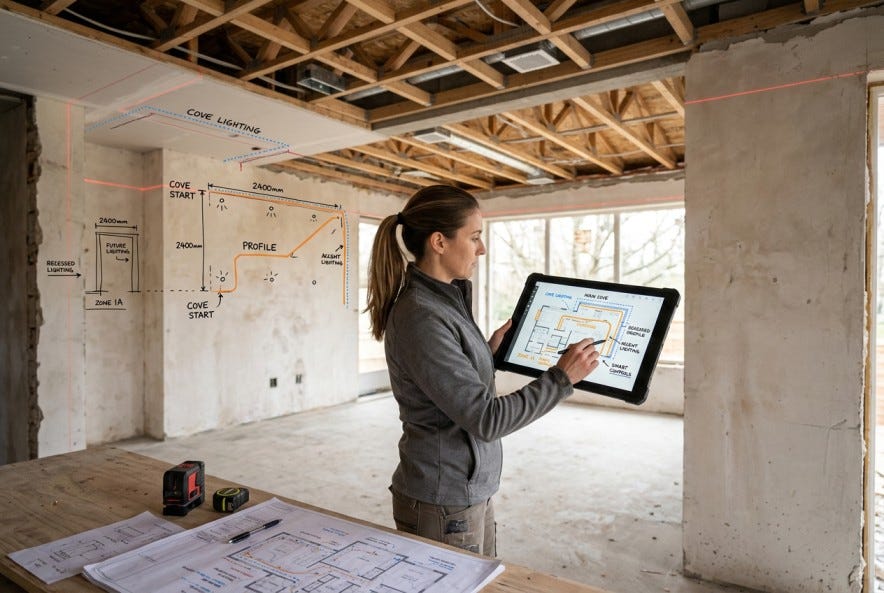
Why Lighting Must Be Planned Before Construction — Not After
Most homeowners think about lighting at the finishing stage — when tiles are done, walls are painted, and the contractor is asking what lights to install. By that point, the most important decisions have already been made — badly.
Conduit routes are fixed. The electrical conduits embedded in your walls and ceiling slabs determine where every light point, switch, and dimmer can go. Change them after plastering and you are cutting into finished walls.
False ceiling design is locked. Cove lighting pockets, recessed downlight positions, and linear profile channels all require specific false ceiling geometry. This must be coordinated with your civil contractor before the false ceiling framework is installed.
Circuit zoning cannot be retrofitted. A properly planned home has separate lighting circuits for each room and zone — living room, bedroom, kitchen, outdoor. This allows individual dimming, smart control, and energy monitoring. Running separate circuits after construction is nearly impossible without major rework.
In our experience working on architectural lighting design projects across luxury residences in India, the homes with the most beautiful and functional lighting are always the ones where the lighting designer was involved at the drawing stage — not after handover.
The 3 Lighting Rule — What It Means for Indian Homes
The 3 lighting rule — also called layered lighting design — is the professional standard for any well-designed interior. It states that every room should have three distinct layers of light, each serving a different purpose.
Layer 1 — Ambient Lighting The base layer. Soft, even illumination that fills the entire room without harsh shadows. In Indian homes, this is typically achieved through cove lighting inside false ceiling pockets, recessed downlights, or ceiling-mounted fixtures. The goal is a comfortable baseline brightness — not task-level intensity.
Layer 2 — Task Lighting Focused, functional light for specific activities. Under-cabinet lights in the kitchen for cooking, reading lamps beside the bed, LED profile channels above the study desk. Task lighting should be bright, directional, and independent of the ambient layer.
Layer 3 — Accent Lighting Decorative and directional. Wall washers that graze a textured surface, spotlights on artwork, uplighters behind plants, facade lighting that highlights architectural features. Accent lighting adds depth, drama, and personality to a space.
The 3 Lighting Layers — Room by Room
RoomAmbientTaskAccentLiving RoomCove lighting, downlightsReading lamp, TV backlightWall washer, shelf spotlightsMaster BedroomCove lighting (2700K)Bedside reading lightWardrobe interior lightKitchenDownlights (4000K)Under-cabinet LED stripsShelf lighting, toe-kick lightBathroomDownlights (3000K)Mirror lightNiche accent lightStaircaseRecessed wall lights — Step riser LED profileOutdoor/FacadePathway bollards — Wall washer, uplighter
Planning all three layers before construction means every conduit, circuit, and switch position is accounted for from the start.
What is the 5'7" Lighting Rule?
The 5'7" lighting rule is a guideline for pendant light and chandelier placement. It states that the bottom of a hanging light fixture should be approximately 5 feet 7 inches (170 cm) above the finished floor level in a standard room — roughly eye level for an average adult.
For Indian homes, this translates directly to: if your floor-to-ceiling height is 10 feet, your pendant or chandelier bottom should hang at approximately 5.5 to 5.7 feet from the floor. Going higher makes the fixture look disconnected from the space. Going lower creates an obstruction.
Over dining tables, the rule adjusts — the fixture bottom should be 2.5 to 3 feet above the table surface for focused, intimate illumination without glare.
Both measurements need to be factored into your false ceiling height, rough-in wiring position, and canopy depth before construction begins.
How to Prepare a Lighting Layout Plan
A lighting layout plan — also called a reflected ceiling plan (RCP) — is a technical drawing that shows the exact position of every light fitting, switch, circuit, and conduit in your home. It is the foundation document your electrical contractor and lighting designer work from.
Here is how to prepare one step by step:
Step 1 — Start with the architectural floor plan Get the floor plan from your architect in AutoCAD or PDF format. This is your base layer — all room dimensions, door and window positions, and structural elements.
Step 2 — Define lighting zones Mark each room as a separate lighting zone. Large rooms like living areas may have two or three sub-zones — TV wall zone, seating zone, dining zone — each on its own dimmer circuit.
Step 3 — Mark ambient light positions Place downlights, cove pockets, and ceiling fixtures on the plan. Follow standard spacing guidelines — recessed downlights in residential spaces are typically spaced 1 to 1.5 metres apart for even coverage.
Step 4 — Mark task and accent positions Add under-cabinet strip positions, reading light rough-ins, wall washer positions, and any decorative pendant rough-ins. Each needs its own conduit and switch point.
Step 5 — Plan switch and dimmer positions Decide where every switch plate goes before the electrician routes conduits. In smart lighting control systems, switches are replaced by KNX touch panels or smart keypads — but the conduit routing still needs planning.
Step 6 — Mark outdoor lighting positions Facade lighting uplighters, garden pathway points, driveway lighting, and terrace lights all need weatherproof conduits and separate outdoor circuits. These are the easiest to forget and the most difficult to add later.
Step 7 — Coordinate with the false ceiling contractor Every cove pocket, recessed downlight cutout, and linear profile channel must be communicated to the false ceiling contractor before the framework is fixed. Changes after the framework is up require dismantling finished sections.
Colour Temperature Planning — A Common Mistake in Indian Homes
Colour temperature (CCT) — measured in Kelvin (K) — determines whether your light feels warm or cool. Getting this wrong is one of the most common lighting mistakes in Indian homes, and it cannot be fixed without replacing the fittings.
Colour Temperature Guide for Indian Homes
SpaceRecommended CCTEffectBedroom2700K–3000KWarm, relaxing, intimateLiving Room2700K–3000KWarm, welcomingKitchen3000K–4000KClean, functional, energisingBathroom3000KFlattering, warmStudy / Home Office4000KNeutral, focusedStaircase2700K–3000KSafe, ambientOutdoor / Facade2700K–3000KWarm, architectural
Tunable white lighting — available through smart lighting control systems — allows CCT to shift automatically throughout the day, supporting your body’s natural circadian rhythm. This is a planning decision that must be made before conduits are laid, as tunable systems require different wiring from fixed-colour installations.
Smart Lighting Planning — What to Decide Before Construction
If you are planning a smart home, the lighting planning stage is where the most important decisions happen. Retrofitting smart lighting into a finished home is possible — but significantly more expensive and limited.
What to decide before construction:
- Protocol selection: KNX wired systems offer the most reliability and flexibility for luxury homes. KNX requires a dedicated bus cable — KNX TP cable — to run to every device. This must be laid during the conduit phase.
- Dimmer type: Phase-cut (leading edge or trailing edge) and ELV (Electronic Low Voltage) dimmers are not interchangeable. The dimmer type must match your LED driver type — decide this before specifying fixtures.
- Sensor positions: Occupancy sensors, lux sensors, and DALI gateways all need conduit rough-ins at specific positions in the ceiling or wall.
- Scene planning: Decide what lighting scenes you need — Morning, Work, Relax, Movie, Sleep, Away — before finalising switch counts and circuit layouts.
At Brightmatic, we work with architects and interior designers from the drawing stage to ensure every conduit, circuit, and device position is correct before a single wall is plastered.
Room-by-Room Lighting Planning Checklist
Use this checklist for every room in your home before construction begins:
Living Room
- Cove pocket dimensions confirmed with false ceiling contractor
- Downlight positions marked on RCP — minimum 4 circuits
- TV backlight conduit rough-in behind TV wall
- Floor lamp conduit outlet position confirmed
- Smart dimmer or KNX panel position confirmed
Master Bedroom
- Cove pocket confirmed — 2700K circuit separate from reading lights
- Bedside reading light rough-ins both sides
- Wardrobe interior lighting conduit — separate switch
- Under-bed LED strip conduit if planned
- Smart panel or dimmer position at entry and bedside
Kitchen
- Under-cabinet conduit rough-ins — one per cabinet section
- Overhead downlight circuit — 4000K separate from rest of home
- Island pendant rough-ins confirmed with 5'7" rule applied
- Toe-kick strip conduit if planned
Bathrooms
- Vanity mirror light rough-in — above or side of mirror
- Shower recess downlight — IP65 rated position confirmed
- Night light circuit — separate low-wattage circuit
Outdoor & Facade
- Weatherproof conduits to all facade uplighter positions
- Garden pathway conduit route confirmed
- Driveway inground conduits — IP67 rated positions
- Terrace and balcony circuits — separate outdoor MCB
- Entrance statement lighting rough-in confirmed
Source: https://www.brightmatic.in/insights/home-lighting-planning-before-construction-india


Comments
Post a Comment