Smart Door Lock — What is it and How Does it Work?
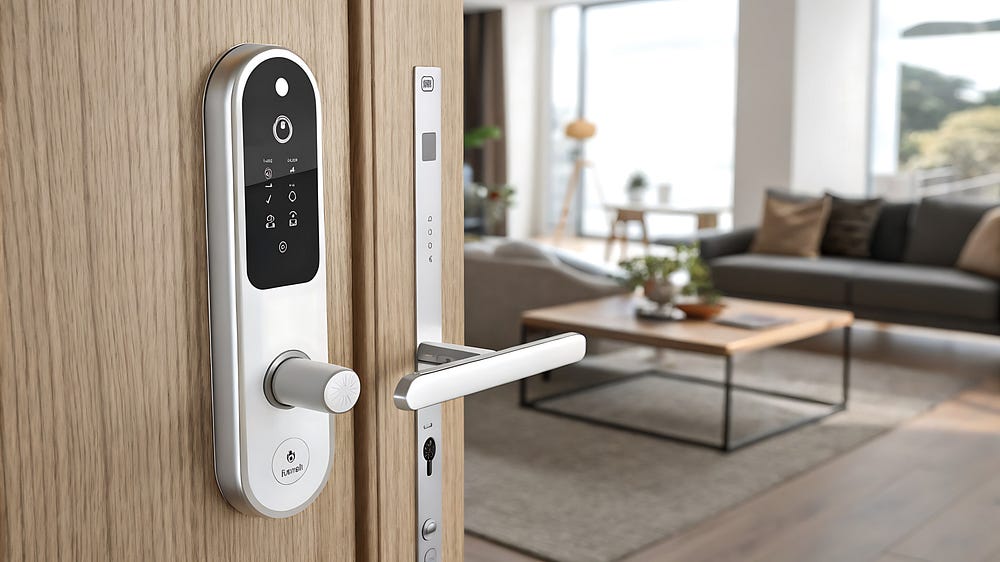
A smart door lock is an electromechanical locking device that replaces the traditional mechanical key with digital authentication methods — fingerprint, PIN code, RFID card, mobile app, or voice command. Unlike conventional locks, smart door locks provide real-time access logs, remote control, and automated locking — all manageable from your smartphone, regardless of your location.
Why Traditional Locks Are No Longer Sufficient
The humble mechanical lock has protected Indian homes for generations. But it has three fundamental vulnerabilities that no amount of engineering can fully resolve.
First — keys get lost. The average Indian household loses or misplaces keys multiple times a year. Every lost key is a potential security breach requiring lock replacement.
Second — keys get duplicated. A physical key can be copied at any local hardware shop in under two minutes, without your knowledge or consent. There is no way to track how many copies exist.
Third — keys leave no record. A mechanical lock cannot tell you who entered, when they entered, or how long they stayed. If something goes wrong inside your home, you have no verifiable entry data.
Smart door locks eliminate all three vulnerabilities simultaneously.
How Does a Smart Door Lock Work?
Understanding the mechanics behind a smart lock removes the mystery and builds confidence in the technology.
The Basic Architecture
A smart door lock replaces only the interior side of your existing deadbolt or latch mechanism. The exterior appearance can remain largely unchanged — important for aesthetic consistency in premium Indian interiors.
Inside the lock, three core components work together:
1. Authentication Module — Receives and verifies the access credential (fingerprint, PIN, RFID, Bluetooth signal).
2. Electromechanical Actuator — Converts the verified digital signal into a physical movement — retracting or extending the bolt.
3. Communication Module — Connects the lock to your home network via Wi-Fi, Zigbee, Z-Wave, or Bluetooth, enabling remote control and real-time logging.
When you place your registered fingerprint on the sensor, the authentication module verifies it against stored templates in under 0.5 seconds, signals the actuator to retract the bolt, and simultaneously logs the entry with a timestamp to your connected app.
Types of Smart Door Lock Authentication
Not all smart locks use the same authentication method. The right choice depends on your household composition, usage patterns, and security requirements.
Authentication TypeSpeedSecurity LevelBest ForMax UsersFingerprint Biometric0.3–0.5 secVery HighPrimary residenceUp to 100PIN Code2–3 secHighDomestic staff, guestsUnlimitedRFID Card/TagInstantHighApartments, officesUnlimitedMobile App (Bluetooth)1–2 secVery HighRemote accessUnlimitedVoice Command2–3 secMediumConvenience usePer smart home setupTraditional Key OverrideStandardStandardEmergency backupN/A
Most premium installations use a combination of fingerprint + PIN + app — creating a multi-factor system where even if one method fails, access is never completely lost.
Smart Lock Features That Matter in Indian Homes
Auto-Lock
The single most requested feature in Indian households. The door locks automatically after a configurable duration — typically 30 seconds to 5 minutes after closing. Eliminates the daily anxiety of “did I lock the door?”
Temporary Access Codes
Generate a unique PIN for your domestic helper that is valid only between 9 AM and 6 PM on weekdays. The code expires automatically. No physical key exchange, no security risk when employment ends.
Real-Time Access Alerts
Every entry and exit generates an instant push notification on your phone. You know exactly when your children arrive home from school, when the cook arrives, and when any unregistered access is attempted.
Anti-Tamper Alarm
Multiple incorrect PIN attempts or physical tampering with the lock hardware triggers an immediate alarm and push notification. Most professional-grade locks trigger after 5 failed attempts, initiating a 30-second lockout.
Passage Mode
For daytime when multiple family members are entering and exiting frequently — set the lock to passage mode, keeping it unlocked during specified hours without requiring authentication every time.
Low Battery Alert
Smart locks run on standard AA batteries with a typical lifespan of 6–12 months. The lock sends push notifications when battery drops below 20% — eliminating the risk of being locked out due to a dead battery.
Smart Lock vs Traditional Lock — Detailed Comparison
FeatureSmart Door LockTraditional LockKey requiredNoYesAccess audit trailFull log with timestampsNoneRemote controlYes — from anywhereNoTemporary accessYes — time-limited codesKey duplication onlyAuto-lockYes — configurableNoAnti-tamper alertYes — immediate notificationNoLost access solutionReset PIN / new fingerprintLock replacementPower dependencyBattery (6–12 months)NoneInstallationReplaces existing deadboltStandard
Communication Protocols — What Powers Smart Locks
The communication protocol determines how your lock connects to your smart home ecosystem. This is a technical detail most installers overlook — but it significantly affects reliability and compatibility.
Wi-Fi — Direct connection to your home router. Enables remote access without any additional hub. Drawback: higher battery consumption, dependent on internet connectivity.
Bluetooth — Short-range, low energy connection. Very fast response when you are near the door. No internet required for basic operation. Drawback: limited range, no remote access without a bridge device.
Zigbee / Z-Wave — Mesh network protocols used in professional smart home systems. Extremely low power consumption, highly reliable, works even when internet is down. Preferred for integrated smart home installations.
Matter Protocol (2026 Standard) — The newest universal standard supported by Apple, Google, and Amazon. Ensures your smart lock communicates seamlessly with all major smart home platforms without compatibility issues.
- In a recent villa project in Sector 150, Noida — we installed a Z-Wave smart lock system integrated with the home’s Brightmatic automation platform. The client can now see a complete daily access log, receive instant alerts for any entry, and remotely grant access to visitors — all from a single app that also controls their lighting, audio-video, and security cameras.
Installation — What the Process Looks Like
Smart door lock installation is significantly simpler than most homeowners expect.
What Gets Replaced
Only the interior locking mechanism and cylinder are replaced in most installations. The exterior door hardware — handle, escutcheon plate — can often remain unchanged.
Installation Time
A standard single-door installation by a professional technician takes 45 minutes to 90 minutes, including configuration, user enrollment, and app setup.
Professional vs DIY
For primary entrance doors — always use professional installation. Incorrect installation creates gaps in the door frame that reduce physical security regardless of how advanced the electronics are. For secondary internal doors, DIY installation is generally straightforward.
What to Check Before Buying
- Door thickness — Most smart locks are designed for 35mm to 55mm door thickness
- Backset measurement — Distance from door edge to center of lock cylinder
- Door material — Wooden doors are straightforward; metal doors require specific models
- Existing deadbolt compatibility — Many smart locks replace only the cylinder, keeping your existing frame hardware
Smart Lock + Security System Integration
A standalone smart lock provides significant value. A smart lock integrated with a comprehensive security system provides exponentially more.
Our smart home security systems at Brightmatic connect your door lock directly with your CCTV cameras, motion sensors, and security and surveillance platform.
What Integrated Operation Looks Like
When an unregistered fingerprint is attempted three times, the system simultaneously triggers the door lock alarm, captures a photo from the nearest camera, and sends an alert with the image to your phone — all within two seconds.
When a registered user unlocks the front door after 11 PM, the system automatically turns on the entrance lighting at 30% warm white — a feature handled by our lighting control system — ensuring safe navigation without waking others.
Smart Door Lock — Budget Guide for India
CategoryPrice RangeWhat to ExpectEntry Level₹8,000 — ₹15,000PIN + RFID, basic app, no Wi-FiMid Range₹15,000 — ₹25,000Fingerprint + PIN + app, Wi-Fi, access logsPremium₹25,000 — ₹50,000+All authentication methods, Matter protocol, full smart home integration
Common Mistakes When Buying a Smart Lock in India
1. Choosing Wi-Fi only locks for areas with unstable internet.
If your broadband goes down, Wi-Fi-dependent locks may behave unpredictably. Always ensure your lock has a local operation mode that functions independently of internet connectivity.
2. Not checking IP rating for exterior doors.
India’s monsoon season puts exterior hardware under significant moisture stress. Always verify your lock carries a minimum IP65 rating for any outdoor or semi-exposed installation.
3. Ignoring the physical key override.
Some budget smart locks eliminate the physical key entirely to reduce cost. This is a risk. Always choose a lock that includes a concealed physical key override for emergencies.
4. Not enrolling multiple users at installation.
Many homeowners enroll only their own fingerprint during setup. Enroll all family members, including elderly relatives, during installation — not as an afterthought weeks later.
5. Buying without checking door compatibility.
Smart locks are not universally compatible with all door types and thicknesses. Confirm compatibility with your specific door before purchasing — especially for heavy wooden doors common in premium Indian bungalows.
Originally Published at: https://www.brightmatic.in/insights/smart-door-lock-what-is-it-and-how-does-it-work


Comments
Post a Comment